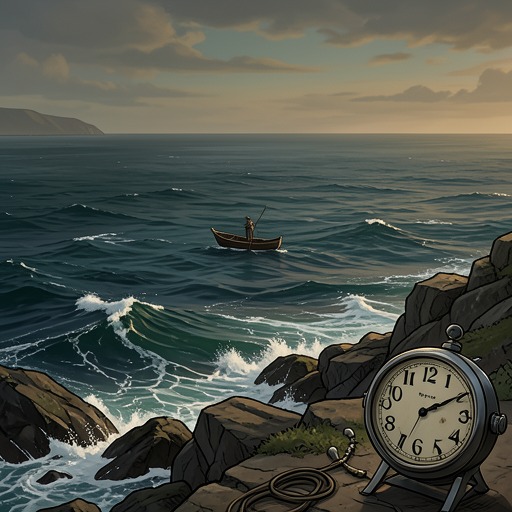
Stones are just stones and rain is just rain and misfortune is just bad luck
All the Light We Cannot See“Stones are just stones and rain is just rain and misfortune is just bad luck” is Daniel LeBlanc’s compact refusal to treat suffering as proof of a supernatural curse. In the novel, the expression is both a father’s reassurance to Marie-Laure LeBlanc and a refrain tested against the legend of the Sea of Flames, the uncertain evidence of everyday life, and the losses that eventually gather around the stone.
A Rational Answer to the Legend
The phrase answers a story in which a prince finds the Sea of Flames after a river dries up. A priest’s dream explains the jewel as a gift from the Goddess of the Earth to the God of the Sea, stolen from its intended course when the prince takes it. The resulting curse promises the keeper eternal life while bringing misfortune, one loved person after another, and can be lifted only by returning the diamond to the sea. The story makes hardship appear purposeful: disaster is not chance but the consequence of possessing the stone.
Daniel rejects that causal certainty. When Marie-Laure is young and struggling with the disorienting world of blindness, he tells her there are no curses, only good or bad luck: each day inclines slightly toward success or failure. His formulation does not promise that bad events will not happen. It denies that they must be evidence of a curse, offering an ordinary account of misfortune instead of a supernatural one.
The Phrase Under Examination
At the museum, Marie-Laure hears conflicting descriptions of the diamond: it is said to be pale green and coat-button-sized, then as large as a matchbook, and later blue and as large as a baby’s fist. The shifting reports feed her imagination; she pictures an angry goddess moving through the galleries. Daniel urges her to temper that imagining and connects the museum’s locks to the rarity of its objects, not to proof of a curse.
Marie-Laure’s question about whether the diamond is real leaves the question deliberately open: she means either the stone or the curse. During another museum visit, she removes her glasses and asks why someone does not simply take the diamond and throw it into the sea. An older boy answers by comparing its supposed size to five Eiffel Towers, turning the solution proposed in the legend into a practical impossibility in the children’s exchange. The moment distinguishes the story’s clean moral remedy from the material scale the children imagine, without establishing that either the jewel or its curse is unreal.
The narrative later returns to Daniel’s reasoning as Marie-Laure wonders whether the old guide was mistaken, whether the Sea of Flames ever existed, and whether her father was right. The question follows a sequence of ordinary observations: Daniel resumes his work, takes her on errands, and no new gemstone appears at the museum. Nor do the employees suffer the plague Marie-Laure had imagined; she herself does not suffer the particular accidents she had feared. These details temporarily support a natural reading, but they are observations, not a definitive explanation of the legend.
Misfortune, Memory, and the Stone
The expression acquires a sharper edge when Marie-Laure later handles the Sea of Flames. She repeatedly picks it up and sets it down, wondering whether one stone could be responsible for her father’s arrest, Harold Bazin’s disappearance, and Madame Manec’s death. Her recollection of Dr. Geffard’s account—that queens might have worn it and wars might have been fought over it—sets the gem’s material presence against the immense meanings people attach to it.
At this point, the saying is no longer simply a child’s comfort. The losses make the curse’s pattern emotionally persuasive, while the evidence does not prove that the stone caused them. The novel places the remembered promise of endless misfortune beside Marie-Laure’s question about whether the gem explains her life, preserving the tension between supernatural causation and coincidence. Its paired assertion that things are things and stories are stories offers distance from the legend, but does not erase the force of the story or the grief attached to the objects and people it names.
Narrative Function
The expression links an early scene of paternal reassurance to a later encounter with the very stone that gives the legend its power. Its plain, balanced clauses resist the curse’s accumulating sequence of deaths and disasters: stone is set against stone, rain against rain, and misfortune against bad luck. That verbal symmetry makes the phrase memorable without making it a final verdict.
The book tests Daniel’s natural explanation through Marie-Laure’s changing circumstances rather than resolving the supernatural question with a conclusive demonstration. The legend supplies a pattern through which losses can be interpreted; the expression supplies a counter-pattern in which hardship remains real but has no necessary magical cause. Their coexistence lets Marie-Laure’s doubt and fear remain intelligible without confirming the curse.